

Patient Stories
Hear stories from multiple myeloma patients about their experiences on ELREXFIO.
Explore ELREXFIO patient stories



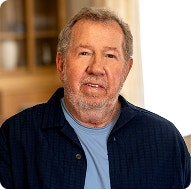
Meet Louis
A devoted husband, father, and grandfather who loves playing the guitar, traveling, and making memories with his family. In 2016, after experiencing persistent back pain, Louis was diagnosed with multiple myeloma.

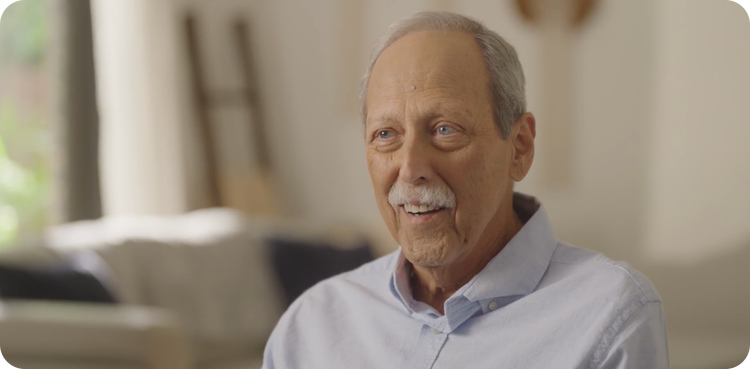
Transcript
LOUIS: I'm an ophthalmologist, an eye surgeon.
My wife was a nurse. I had two children, two grandchildren, very proud of them all.
I’d retired in 2012. We traveled. We hiked. We had a pretty healthy lifestyle.
Nobody ever wants to hear the words “you have cancer.”
It wasn’t the greatest news to hear so early into my retirement, but life throws you things and you just have to deal with them.
For several weeks, I had a backache that wouldn’t go away. It just didn’t feel right. My wife is a nurse and suggested I get an X-ray that didn’t show anything abnormal.
After we got the X-ray, the doctor said, “Well, maybe you should get some blood work done.”
We got some blood work done and that blood work led to a referral to an oncologist.
The oncologist, after a bone marrow biopsy clearly showed that there were myeloma cells, gave me the diagnosis of multiple myeloma.
And all of a sudden you said, "Well, I didn't think this was ever gonna happen,” and then the next thing you know, it hits you that you have cancer.
We said, "Well, let's fight. Let's fight this.”
Over the last eight years, I’ve been on several treatments.
What we knew was that after each line of treatment, it got harder and harder to find a medicine that was going to work.
After a while, some medications stopped working.
The doctor recommended a medicine that had just been approved, ELREXFIO.
He told us ELREXFIO is a prescription medication used to treat adults with multiple myeloma who have received at least four treatment regimens and their cancer has come back, or did not respond to prior treatment.
We discussed the potential side effects and together we decided to move forward with the treatment.
During the first week, I received two smaller doses in the hospital to be monitored for serious side effects.
After completing these doses, I began receiving once-a-week treatments.
Two months later, I had blood work done, and my treatment was working. Several months after that, additional testing showed I was still responding to my treatment.
They did a bone marrow biopsy, and the bone marrow biopsy, he looks at me and says, "Well, you're MRD-negative," and I had never even considered that possibility in the past eight years.
MRD stands for "minimal residual disease." What essentially it means is that they cannot, according to their detecting abilities, find any myeloma cells in my body.
We were pretty shocked. I'm kind of still in shock.
If you've been dealing with something for eight years, it's almost, you know, impossible in a period of a short time.
This was the most remarkable thing I had ever come across.
I started with weekly injections and now after six months, I receive an injection every two weeks. There were some side effects to deal with, tiredness, loss of appetite, aches and pains.
It got better as things progressed. Please remember, this is all just my experience, and others could be different.
CHARLENE: We have a new lease, more hope. We can create new memories. We can spend time with our grandchildren, we can travel. This medicine has given us hope.
LOUIS: There are certain days in your life that you remember really well: the day you get married, the day your children are born.
When someone says, “You can’t detect the cancer anymore,” that’s a day that is a very powerful day.
We don’t know how long this is going to last. Where we are at this point is we’re planning traveling, seeing our kids. The idea is to make more memories and that’s what we’re going to do.
Patients were asked to share their personal stories about ELREXFIO. All content was accurate at the time of publication and may have since changed.
June 2025
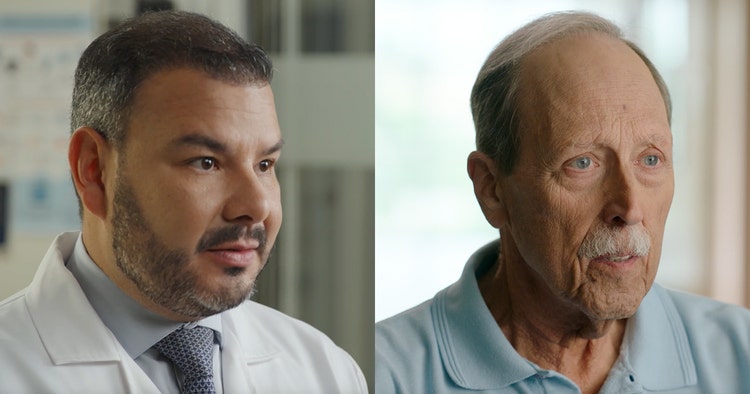
Understanding ELREXFIO: A Doctor and Patient Perspective
Join Dr. Grajales-Cruz and Louis as they share their perspectives about how ELREXFIO works, what Louis felt and learned along the way, and what others starting therapy might expect
Transcript
Hello, my name is Dr. Grajales-Cruz. I'm a Board-Certified hematology oncologist with a focus on treating patients with multiple myeloma. I'm here today to provide information regarding treatment with ELREXFIO also known as elranatamab and what your experience may look like.
I'm joined by Louis; he'll shed some light on his experience as a patient with multiple myeloma and his treatment journey with ELREXFIO.
Let's talk about multiple myeloma for a moment.
As you may know, multiple myeloma is a type of blood cancer that arises from plasma cells inside the bone marrow.
In healthy bone marrow, plasma cells produce antibodies to help fight infection.
In multiple myeloma, plasma cells are transformed into cancer cells that grow out of control, crowding out the normal cells that help fight infection.
There has been a remarkable evolution of multiple myeloma treatments over the years. Since 2010 there have been more than a dozen therapies approved and in the past few years several treatments have emerged with more on the horizon.
This includes standard therapy options like immunotherapies.
The treatment we will talk about today is ELREXFIO also known as elranatamab.
ELREXFIO is a prescription medication used to treat adults with multiple myeloma who have already received at least 4 treatment regimens, including a proteasome inhibitor, an immunomodulatory agent, and an anti-CD38 monoclonal antibody to treat their multiple myeloma, and their cancer has come back or did not respond to prior treatment.
So, how does it work? ELREXFIO is a type of treatment called a BCMA-directed antibody, also known as a bispecific. It destroys myeloma cells by binding to both CD3, a protein found on the surface of T cells, and BCMA, a protein found on the surface of B cells. ELREXFIO binds to both myeloma cells and T cells then activating the T cells to help destroy myeloma cells.
ELREXFIO was studied in a clinical trial of people with relapsed or refractory multiple myeloma.
In a group of 97 patients who had never tried a BCMA-directed therapy and had already been on at least 4 prior treatment regimens, 58% achieved a response.
Most of the responses were a very good partial response or better.
Of people who responded to ELREXFIO, 82% were predicted to still be responding at 9 months, which is known as the duration of response rate.
ELREXFIO was approved based on patient responses and durability of responses. There are ongoing studies to confirm its clinical benefit.
Let's talk about how ELREXFIO is administered. It's given by your healthcare provider as an injection under your skin, what we call a subcutaneous injection, usually in your stomach area. Your thigh or another area of your body may also be used.
ELREXFIO is also a monotherapy, or a single therapy which means it's not given in combination with other multiple myeloma therapies.
Now, let's talk about what you can expect starting ELREXFIO.
During your first week you'll begin with 2 "Step-up" doses of ELREXFIO. Building up to a full dose, which will help your body's immune system adjust. You'll be hospitalized during these first 2 doses so your healthcare team can monitor your symptoms for cytokine release syndrome (CRS) or neurological problems.
Your first full treatment dose will be your 3rd dose, which you will receive on Day 8.
Before each step-up dose and the first full treatment dose of ELREXFIO, you will receive medicines to help reduce your risk of CRS, a serious side effect.
Then after completing the "Step-up dosing" schedule you will likely begin weekly treatment with ELREXFIO at your healthcare provider office or another outpatient setting.
After 6 months of treatment, if you have had a partial response or better for at least 2 months, an every other week dosing schedule could be right for you. After maintaining a response on an every other week dosing schedule for 6 months, a once monthly dosing schedule, every 4 weeks, could be right for you.
ELREXFIO may cause side effects that are serious, life-threatening, or can lead to death, including cytokine release syndrome and neurologic problems.
CRS is common during treatment with ELREXFIO.
Always tell your healthcare provider or get medical help right away if you develop any signs or symptoms of CRS or neurologic problems.
ELREXFIO is available only through a restricted program called the ELREXFIO Risk Evaluation and Mitigation Strategy, or REMS. It is your care team's responsibility to complete the REMS program prior to your treatment, but important that you carry your Patient Wallet Card with you.
Hi, my name is Louis. I've been living with multiple myeloma for eight years and I have been on several treatments over the years. After each treatment eventually stopped working it got harder and harder to find a medicine that was going to work.
After my most recent relapse, my doctor recommended that I try ELREXFIO. We discussed the potential side effects and together we decided to move forward with the treatment.
Overall, the hospital experience went extremely well. It was like clockwork, and their people were very well-trained. When I was supposed to receive treatment on the hour, the person administering my treatment came in on the hour. No delay. No nothing. It was really quite impressive.
It was comforting to have them monitoring for side effects so often.
A week after my "Step-Up" dosing in the hospital I went to my doctor's office and got the beginning of what they call the first dose.
I began receiving once-a-week treatments. Then it went to every two weeks and now I go once a month.
My current treatment schedule is great. We travel. We love to go cruising. We can spend more time visiting our grandkids.
This is just my experience; others may be different.
If you'd like to learn more or are getting ready to talk with your doctor, head over to ELREXFIO.com.

Ready to share your story?
If you are living with multiple myeloma and have been prescribed ELREXFIO, we want to hear from you. By sharing your journey, you can bring hope to others going through similar experiences.
You may submit your story by emailing or calling us using the contact information below.
Learning about your experience with ELREXFIO may be helpful for patients who are considering treatment or have already started. Your story may appear on ELREXFIO.com and in other ELREXFIO support or outreach materials.
Thank you for your interest in sharing your new chapter with ELREXFIO. By sending us your story, you confirm you are 18 years or older and are a United States resident.
Additionally, you affirm that you or a loved one has been diagnosed with relapsed or refractory multiple myeloma and has been prescribed ELREXFIO for relapsed or refractory multiple myeloma by a certified healthcare provider.
Sign up to receive information that will help you feel more confident managing your treatment.
ELREXFIO Results
ELREXFIO was studied in a clinical trial that included people with relapsed or refractory multiple myeloma.

Turn to Pfizer Oncology Together to learn about financial assistance resources and get one-on-one support from a Patient Access Navigator.